By: Jason Dodge
Bing just gave search marketers something they’ve been asking for: real data on how content performs inside AI-generated answers. Available inside Bing Webmaster Tools as a public preview (beta), the new AI Performance Report surfaces grounding queries, citation counts, and page-level citation activity pulled from Microsoft Copilot, Bing AI Summaries, and select partner integrations.
To understand what early signals this data might reveal, we pulled from fifteen brands across a diverse cross-section of industries. The goal wasn’t a definitive study — it was to surface early patterns worth paying attention to.
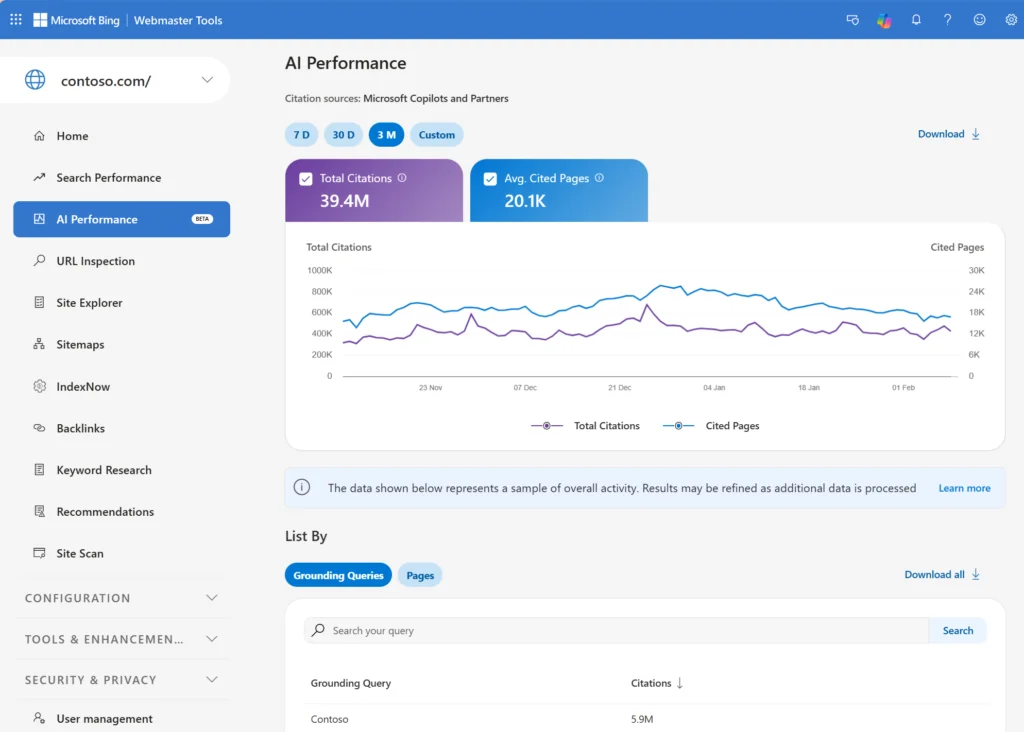
Wanting to understand this more and gauge what early signals could even be telling us, we pulled data from fifteen different brands that provide us with a diverse cross section of industries. While there certainly will be larger datasets to work with, the goal was to provide early signals.
Sticking with our belief that client/brand data is their data, we’ll keep this anonymous, but here’s what we found.
The Dataset
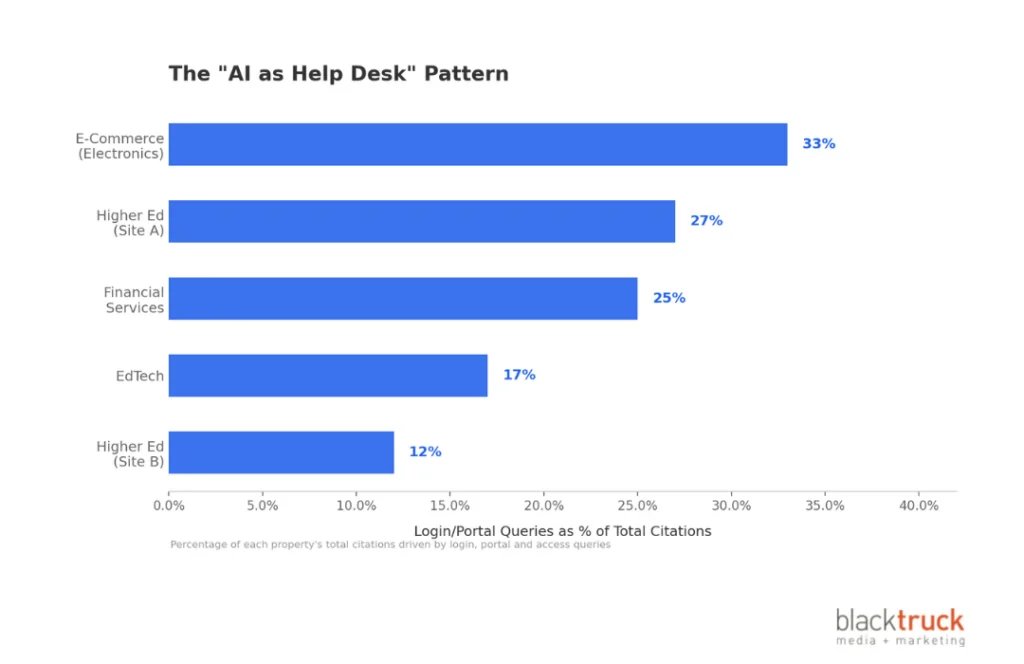
Our quick sweep across the brands we included resulted in a dataset of just over 365,000 total AI citations across more than 2,500 unique grounding queries. All of this in an effort to provide a very broad view into what we’re seeing.
- Travel & Tourism: Includes sites such as destination marketing organizations (DMO), resorts, and other hospitality type brands
- E-commerce: Consumer products that are more specialty online retail, outdoor gear, automotive aftermarket, etc
- Manufacturing: Heavily B2B focused within manufacturing, technical engineering services and support products
- Higher Education: Institutions such as university and college types
- EdTech: Virtual learning and educational platform based brands
- Financial Services: Personal and commercial banking, inclusive of lending
- Government or Adjacent: Government supported business services
- Healthcare: Clinic, specialty care or dental
Leveraging internal AI tools to assist in processing, the data available covers how often a site’s content is being cited as a source in AI-generated answers, and which grounding queries are triggering those citations. Note: This isn’t click data or traffic data as Bing hasn’t released that yet nor do we know if they will. You could likely align this with click data at the page level and we’ll plan to review that in deeper analysis. The focus here is how an AI system considers your content to be trustworthy enough to reference it when generating answers.
Numbers At a Glance
Citation volume varied widely from roughly 450 citations on the smaller end (e-commerce) to 160,000 on the larger end (EdTech). Raw volume isn’t the story. The patterns are.
There are few items that jumped out immediately across all properties we reviewed.
AI Is Being Used as a Help Desk
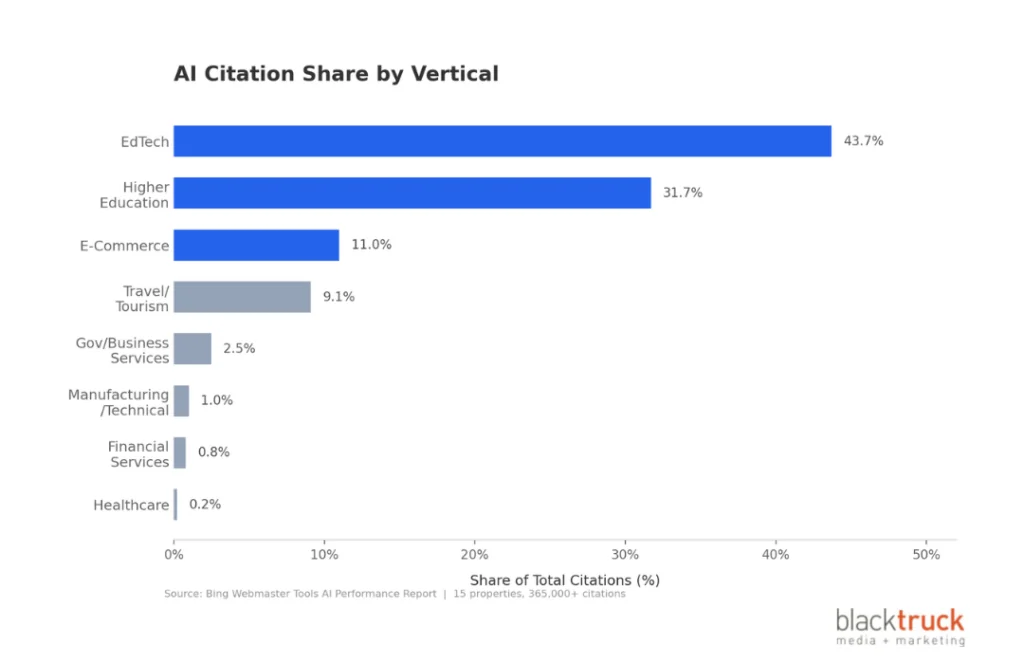
The strongest signal across nearly every vertical: login queries, portal access, and product support are dominating citation volume.
In higher education, student portal login queries alone accounted for 27% of one institution’s total AI citations. In EdTech, login and portal access tied up 17% of all citations. One e-commerce brand saw a single product app query drive 33% of its entire citation profile. Financial services showed login-type requests as the second-highest citation driver at 25%.
What this tells us is that behavioral shifts are happening at a scale much larger than search. People are using AI assistants and agents as navigational layers asking them to take them somewhere they already know exists. AI is then citing your website as the answer. The implication for brands is straightforward: if your site has login portals, support documentation, or product setup guides, that content may already be your biggest AI citation driver.
What Should Your Brand Take Away From This Data?
Audit these pages for accuracy and structure. Make sure they genuinely help people when they arrive. Ask whether your brand is actually owning the post-sale support conversation — because if you’re not, AI will fill that gap with whoever is.
One Piece of Great Content Can Dominate Your Entire Citation Profile
Several properties in our dataset had their AI citation profiles shaped almost entirely by a single content area.
One B2B business services organization saw 87% of its total citations come from a single topic — a thorough, authoritative explainer on state-level employment law. AI systems latched onto it across dozens of query variants: different phrasings, abbreviations, and year-specific searches all resolving back to the same page.
On the financial side, fewer than 20 unique grounding queries captured roughly 16% of one institution’s entire AI citation activity — all driven by a single blog post on how to stop spam phone calls related to mortgages and loans. One practical, helpful piece of content punched well above its weight.
In higher education, a legacy library tool built years ago drove 30% of all citations, including dozens of misspelling variants that AI still resolved correctly. The same institution’s academic research archives accounted for another 7%, drawing in users with no connection to the school at all.
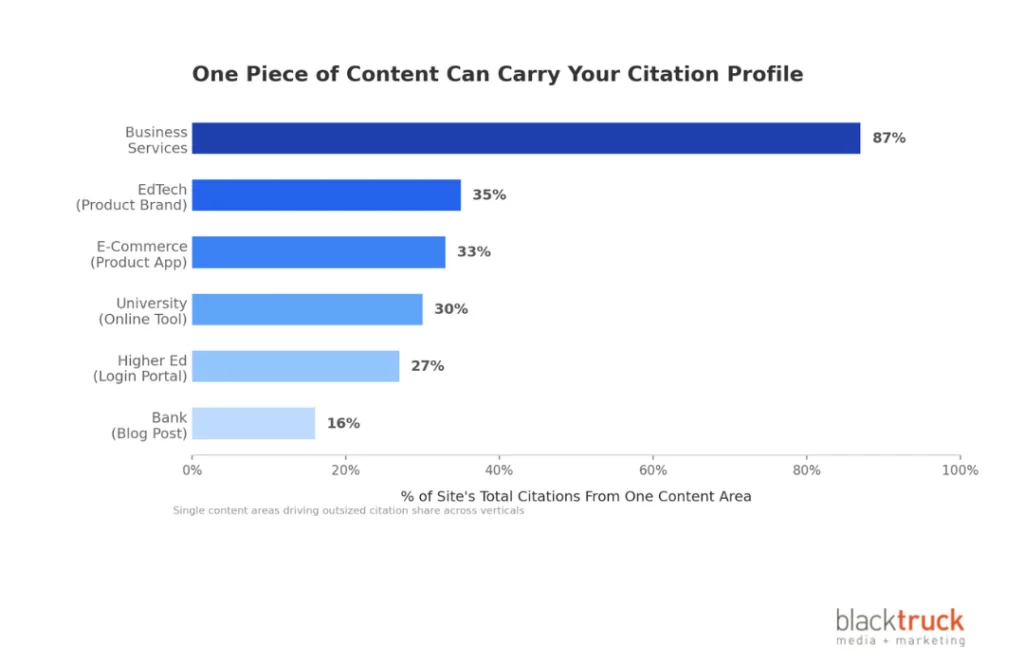
What’s the lesson? You don’t need a massive content library to earn meaningful AI visibility. Depth, accuracy, and genuine helpfulness matter far more than volume. This aligns closely with Google’s own quality rater guidelines framework and it’s not a coincidence.
Travel and Tourism – Well Positioned, but Have Gaps
Across 714 unique grounding queries from DMOs and hospitality brands, a few clear patterns emerged.
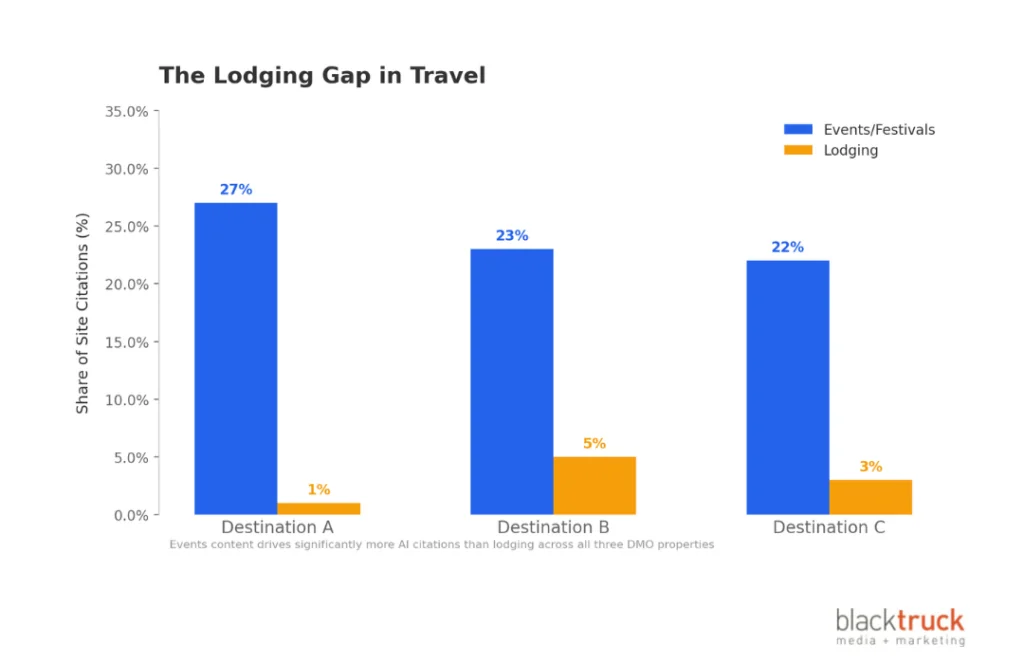
Event and festival content was the strongest citation driver. Annual and recurring seasonal events like holiday programming, signature cultural experiences consistently generated the highest citation share. For one destination, event-related queries drove more than 27% of all citations.
Lodging intent told a different story. It accounted for less than 1% of all citations — an early signal that if you’re not directly tied to hotel or property inventory, you’re unlikely to appear in AI-cited answers for accommodation queries.
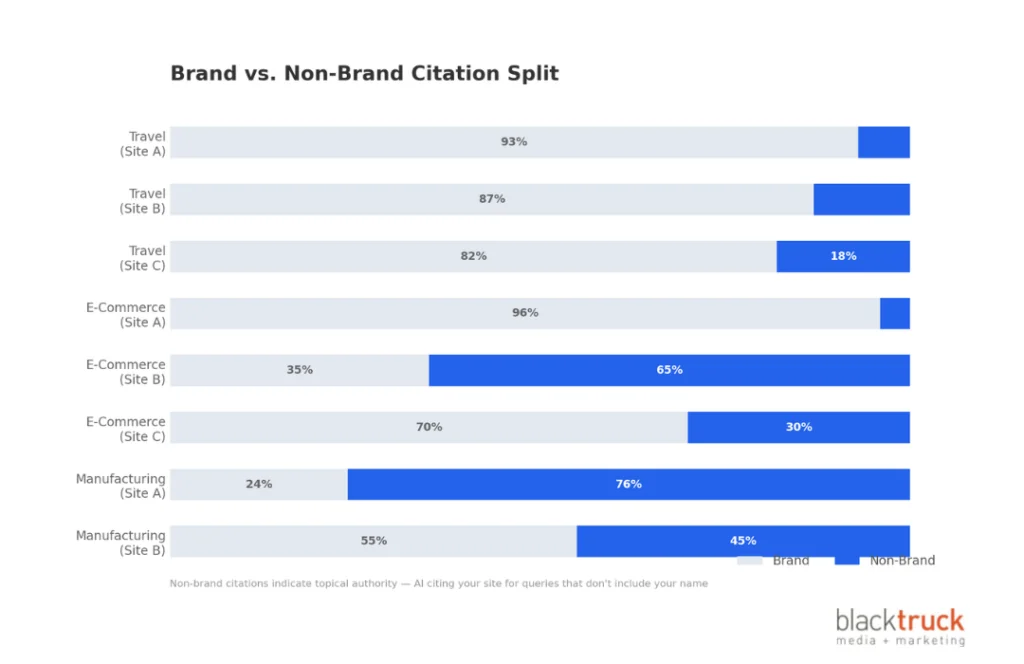
Branded destination queries dominated across the board, making up between 82% and 93% of all citations. This is a healthy signal of authority that DMOs bring to both generative search and traditional search. The lower non-branded citations suggest room to grow on the category-level of travel queries that don’t mention the name.
What does this mean in non-geek language? If you’re a DMO, you likely are being cited and mentioned as it pertains to the destination, your region, etc. But if the audience is unclear on where exactly they want to travel, and perhaps they’re just interested in warm destinations that are ideal for family adventure, there’s likely an opportunity for you to make improvements.
EdTech and Higher Education are AI Citation Powerhouses
Education was the highest-volume vertical in our dataset by a wide margin, accounting for more than 75% of combined citations across higher education and EdTech properties.
In EdTech, misspelled brand queries were notable — roughly 6% of all citations came from misspelled name variations, with another 17% tied to login and portal access. AI is clearly resolving user intent, not just matching keywords.
In higher education, the most striking finding was what AI is actually citing institutions for. Free online tools accounted for 30% of citations. Open course materials and research archives made up another 25% combined. Traditional admissions and academic program content underperformed all of these. AI is citing universities for what they give away, not what they sell.
Takeaway for higher ed marketers: Your institution’s AI visibility is likely being driven by resources you’ve never thought to optimize like library tools, open courseware, and research archives that have been sitting on your site for years.
Category Authority Drives Citations for B2B Services and Manufacturing
B2B had the smallest citation volumes in our dataset, but some of the most telling signals when it comes to query sophistication.
One manufacturer produced 107 unique grounding queries, 76% of which were non-branded. Microsoft’s AI systems were citing this brand for broad, category-level queries about specific industrial processes — exactly the kind of top-of-funnel visibility that a well-executed GEO (Generative Engine Optimization) strategy should aim for.
That same brand also appeared in grounding queries across four languages beyond English, suggesting its content is being cited in AI answers serving an international audience. For companies with global operations, multilingual AI citations are a signal worth tracking, and potentially investing in. This also dovetails back into making sure your foundational and technical SEO elements are solid. If you’re a global brand and don’t have a strategic approach for how you’re going to handle Hreflang, that’s a missed opportunity.
Smaller, regional B2B brands in the dataset showed modest volumes but highly specific grounding queries tied directly to their areas of expertise. The consistent signal: focused, authoritative content in a narrow vertical can earn AI citations regardless of company size. If you’re looking to mitigate the AI takeover of local SEO, take note here.
E-Commerce Brand Authority Is Not What You’d Expect
Citation volumes varied widely across e-commerce, and the source of those citations was often surprising.
The largest e-commerce property’s citations were overwhelmingly product support or support-adjacent: app setup, login troubleshooting, firmware updates, device configuration. AI has effectively become that brand’s support agent.
One notable data point: a brand-to-non-brand citation split of roughly 35% to 65%, with the majority of citations coming from queries about third-party products and manufacturers the site carried. AI was citing this retailer when users asked about specific brands it stocked — a signal that the site had built topical authority well beyond its own brand name. For product manufacturers, this is worth paying attention to: your retailers may be owning your brand story in AI-generated answers.
Financial Services and Healthcare Provide Early Signals
Financial data in our set was limited to 20 grounding queries, but the signals aligned with broader patterns. Login and support queries led, as expected. The standout was a single blog post on stopping spam calls related to mortgages and loans, which drove over 16% of that institution’s citations across multiple query variants — demonstrating that even smaller, regional financial brands can compete with national players through practical, customer-focused content.
In healthcare, the strongest signals came from access-focused queries: finding providers that accept specific insurance, locating practices taking new patients, and finding affordable care nearby. Educational content on basic preventive health also performed well. Both point toward the same opportunity: if you clearly communicate how patients can find you, what you accept, and how you solve common access problems, AI is more likely to cite you.
Key Takeaways from Early AI Citation Signals
AI systems are rewarding utility above all else right now.
Across every vertical, the content earning the most citations isn’t promotional, it was useful. This isn’t a case of brand storytelling and “vibes.” Useful content such as online tools, support, documentation, how-to guides, login portals, and practical advice is what consistently outperforms marketing-oriented content. If your site helps people do something, the probability that AI cites you will increase.
Support content might be your biggest AI Asset.
If one pattern presented itself the most, it’s that of the “AI as a help desk.” This was prevalent across e-commerce, EdTech, higher education, and financial services. If your site has support documentation, setup guides, FAQs, or portal access pages, you should be auditing them for accuracy and structure. These resources are likely already being cited, and you want to own as much of that narrative as possible.
Citation profiles can be carried by a single piece of content.
Contrary to what you might have been sold in the past, you don’t need a massive content operation to earn meaningful citations. You do however, need depth on the topics that matter most to your audiences. The facts don’t lie here either. We found that 87% of a site’s citations all referenced a state employment law explainer principles. A consumer advice blog post drove 16% of their citations. Free tools pulled in over 30% of citations for another brand.
Brand citations are the floor, not the ceiling.
Most sites have earned the majority of their branded queries. This ties back into the blunt fact that LLM knowledge cutoff dates are not discussed enough in marcom conversations. The real generative engine optimization (GEO) opportunity is non-branded citations. Earning the visibility when AI answers questions that don’t include your name. The sites and brands doing this well now, already have deep content that covers the broader topic space around their products or services.
Misspellings and query variants matter.
Google has handled misspellings since it was introduced to the search experience back in 2004. AI systems are handling the messy input of humans far better these days. While it’s not something you need to be optimizing for, you should take stock in how frequently it happens as it underscores the fact that AI is resolving the user intent, not matching keywords.
Citation data is NOT business outcome data.
Let’s be clear about what this review does and doesn’t tell us. It shows how often your content is cited in AI-generated answers. Period. It doesn’t show whether those citations drive clicks, traffic, or even conversions. That gap matters when you’re looking to align your digital marketing data and plan for larger conversations when C-suite sees you’re showing up in AI overviews, but you still can’t justify “why” that is important. For now, it’s a leading indicator of AI visibility, nothing more and nothing less.
What Comes Next?
This is day one with data from a tool that’s still in beta. Sample sizes will grow, metrics will evolve, and Bing may eventually connect citation activity to traffic and business outcomes. In the meantime, if you haven’t set up Bing Webmaster Tools, do it now — it’s a straightforward signup, and you can import your site directly from Google Search Console.
Also worth doing today: create custom channel groups in GA4 to capture AI-referred traffic. You can’t optimize what you don’t measure, and for the first time, there’s engine-level data you can actually point to.
If you’re not sure what to make of your data or you want help building a strategy around AI visibility and Generative Engine Optimization, that’s what we do. Reach out and let’s look at it together.