Every week brings a new tactic promising to crack AI search. Most of them are noise. So when Google hosts an event and spends the day telling marketers to keep doing what they’re already doing, it’s worth paying attention to what they mean by it.
Joelle Irvine joined us on a recent episode of The Redirect Podcast to recap a Google Search Central Live event. In this episode, we translated the event into what was said by Google, and what it means for content marketing, AI visibility, and how brands should be measuring any of it.
The common theme throughout the entire day was consistent. And that’s the foundational SEO work still matters, because AI Overviews and AI Mode need grounded data to produce answers. The harder question, the one that doesn’t fit on a slide, is whether your team is actually built to produce the kind of content that earns visibility.
Tap into the episode below or skim the takeaways and action items further down.
Commodity vs. Non-Commodity Content Argument
Google shared a commodity vs. non commodity content example at Search Central Live in Toronto. While not overly rare for Google to share some insights, this slide dominated the online marketing chatter.
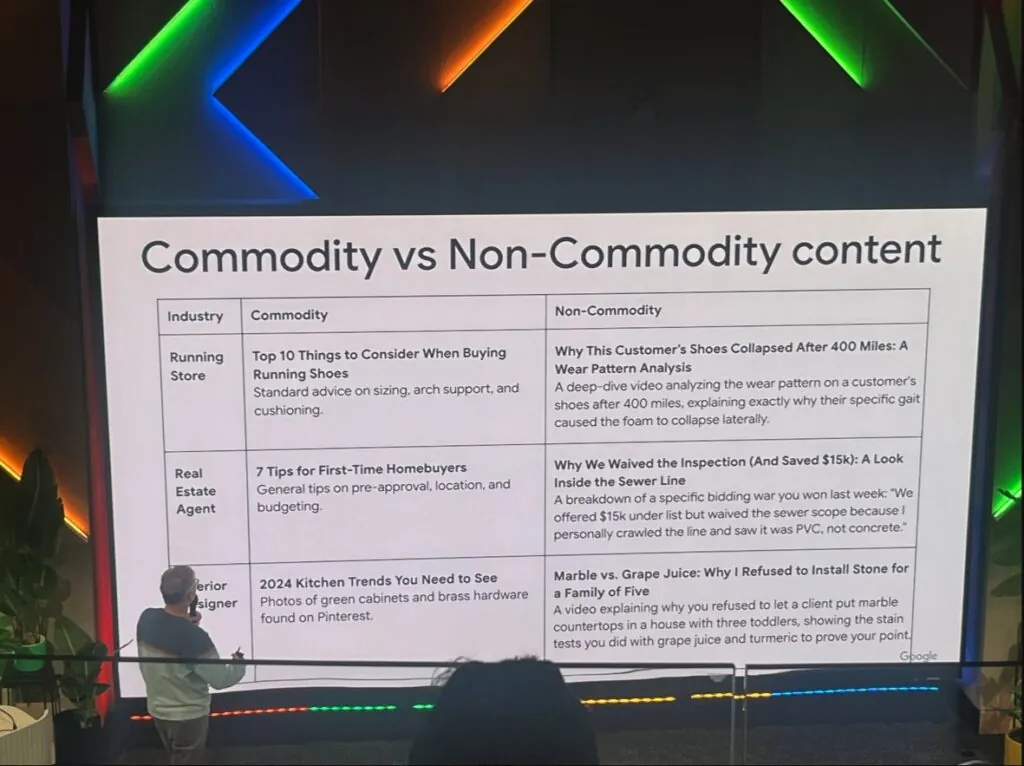
Google Search Central Live – Toronto
What is Commodity Content?
Commodity content is high-volume content that is easy to produce and everyone has it. Content such as “Top search engine marketing firms in Grand Rapids, MI.” Or the “top 10 things you need to consider when hiring a digital advertising agency.” Much of this content is either self-promoting listicals aimed at gaming the algorithm, or is recycled content that is repurposed season after season. Often times commodity content is written with popularity in mind, leveraging keyword research to hone in on popular topics that are loosely associated with your brand. Sometimes, not at all.
“It’s a story and a point of view. The LLM isn’t going to generate that out of thin air.”
– Jason Dodge
What is Non-Commodity Content?
Non-Commodity Content is purposefully crafted content that has a point of view, often with a person behind it. This type of content typically has a genuine point of view, backed by original data or insights that you will not find anywhere else. Examples of non-commodity content could include things such as “why we stopped tracking AI visibility the same way you track SEO rankings, and how to approach successful metrics.” The core focus on non-commodity content as it pertains to AI and LLMs, is that an LLM cannot generate a genuine point of view out of thin air – but you and your brand can.
Did Google Change the Rules Again?
No. We’ve been in the search marketing industry for the better part of 20 years and can tell you this really isn’t anything new. What Google did do was highlight the things that were already happening.
On-SERP SEO and Zero-Click behavior is not new. Featured snippets are more than a decade old at this point in time, and the industry has done a poor job explaining it by telling everyone to create non-commodity content that is partly self-serving. Generic AI answers need unique, grounded source data to improve it’s responses. Compare this to the mobile-first push that we witnessed years ago. The technology and the market was already headed in that direction, and Google amplified it.
How to Create Non-Commodity Content at Scale
The instinct is right around the concept that bandwidth is always a problem. Most teams default to commodity content because it’s easy to produce. You go to your keyword research tool of choice, sift through the popularity contents that is search volumes, and generate your articles.
Do create non-commodity content at scale, you need to start with data you already own. That could come from analytics, search console trends, third-party tools, in-app and customer data, transcripts from your customer service reps, sales calls, etc. The value AI is bringing to the table isn’t this information, it’s speed at which it can move through qualitative data to surface the most-asked questions, highlight the biggest pain points, and where you actually differentiate as a brand.
Anchoring your data alongside content that represents the job to be done. Case studies are a strong example, where leaning into the real-world examples that are backed by data to build trust and skip the top-of-funnel content that isn’t converting to begin with.
“We really need to understand what’s driving those decisions”
– Joelle Irvine
Articles Might Not Be Your Best Content
This might be a bit of a hot take, but your best content might not be a blog article. At Search Central Live, Google showed a spreadsheet of articles, but the format depends on your audience and how they consume it. But don’t follow those instructions blindly, and don’t create based off of a popularity contest that your brand never had a reason to be involved in. Understanding your audience is a key marcom function as we navigate this next generation of online visibility. Non-commodity content could be a social post, a video, a podcast, etc. It really depends on who your audience is and where they are hanging out.
Non-Commodity Content Stalls in the Boardroom
Non-commodity content takes time and a willingness to publish a point of view, and this can feel risky to brands and those in the C-suite. Producing content, really good content that people engage with, is not the type that can fall on a solo SEO producing 100 articles a month. Non-commodity content requires a mindset shift and cross-team buy-in. The approach you take will be different based on your brand and your customers. The good news is, SEOs are natural skeptics and ones who test before deploying at scale. You have to prove the worth of these pieces of content and we would encourage you to not let the opinions of the highest-paid person in the room dictate what might be best for your customer engagement and online value.
The Myths Google Put to Bed
- llms.txt file will not help or hurt you for Google’s AI Overviews. Their value for other tools of course is unknown.
- Gemini is used in AI Overviews and AI mode in search, but it is not the same experience as the consumer Gemini product you interact with.
- Much of what’s marketed as AI search optimization are tactics that sound technical, yet repackaged into a service offering. Google can already render JavaScript (AI bots cannot), read structured data, and understand intent.
Understanding Schema and Structured Data
Structured data helps most where the LLMs are weakest. Consider elements such as precise pricing, shipping, product variants, loyalty data, ISO formats, etc. It reduces the time to compute and improves accuracy. It is not the end game and certainly does not mean you’re going to see success in generative search just by deploying structured data. As Ryan Levering from Google’s Search Engineering Team framed it as somewhere between important and over-indexing to game the system.
“Google is inherently lazy. They don’t want to crawl your entire site, so make it easy for them.”
– Jason Dodge
Paid and organic search reinforce each other and are grounded in structured data. We see this with e-commerce brands where a strong Merchant Center feed is really strong SEO. Good SEO makes shopping and Performance Max (PMax) ads better.
Google Trends, An Underused Tool in Search
We’re often quoted as stating that search is a great unifier, especially for B2B marketing. You don’t always get to know who is performing a search for what it is you do or sell. Keywords tell us what people want in a moment, and a trend tells you who people potentially are. Google Trends is often an underutilized tool in the tech stack by marketers. Described as the largest real-time data set on human curiosity, it only has around a three-minute lag and five years of history. What can you do with it?
- Identify a breakout queries or identifying gaps
- Verify themes and topics by sub-regions using real geographic data
- Combine individual elements that AI is likely already surfacing
One word of caution. Much like every other tool out there, Google Trends is directional and not predictive. You want to filter every breakout against whether it maps to your business and your audience before chasing it.
How to Measure Visibility in the Age of AI
Visibility means different things to different people, and you need to define it before you head down the path of employing tools that claim to measure it. Keeping in mind, you should not be measuring AI visibility like you do traditional search rankings.
Marketers are being told to optimize for things that they cannot even measure effectively yet, or are using old KPIs that don’t align. Watch the jobs-to-be-done trap by trying to compare yourself against brands that answer the same question, but aren’t actually your competitors.
KPIs such as share of voice, and the sentiment around how you’re being mentioned, combined with intent, are reasonable signals to start reviewing. Taking note of how your brand is being talked about online, and how accurate that information is. These all can be used as guideposts to assist in developing a more diverse digital presence in search and generative AI responses.
Red Flag Signals for AI Visibility Tools and Agencies
Like most things, buyer beware. If a vendor is selling you precise AI Overview attribution today, ask how they got data Google itself says doesn’t exist yet. Let alone account for the semantic differences in how individuals search, and the impact personalization has on results.
“If it seems too good to be true right now, it probably is.”
Joelle Irvine
Ignore the Headlines and Focus on Your Brand Strength
We’ll close this episode of The Redirect Podcast out by challenging you to ignore the headlines for a week and focus intentionally on what your brand is genuinely known for and good at.
Search has always been a very reactive industry, and what works for one brand in one industry, won’t automatically work for yours.
If you’re trying to separate what’s real in AI search from what’s being sold, let’s connect. No buzzwords, no guarantees. Just an honest conversation. Schedule a time to talk.
Additional Resources
[listen] From Headlines to SERPS – Where PR Meets SEO
[listen] AI Optimization: Separating Hype from Reality on The Redirect Podcast
[read] Leveraging Strategic Partnership to Grow Organic Revenue and Boost Visibility
[read] Structuring B2B Google Ads Campaigns for Long Sales Cycles
Explore The Redirect Podcast over on YouTube as well.