Thanks for joining us at One West MarTech Summit in beautiful Oceanside, California.
If you’re here, odds are you are looking for those handy resources and key takeaways that were mentioned to help you out. Look no further than the link below and good luck!
If you like what we shared and would welcome more – consider signing up for our bi-monthly newsletter. We promise to deliver actionable insights and not spam you!
Curious to know how visible you are in AI?
Take the assessment and we’ll share the results with you all to see how the industry is shaping up.
Get the deck here on our Speaker Deck
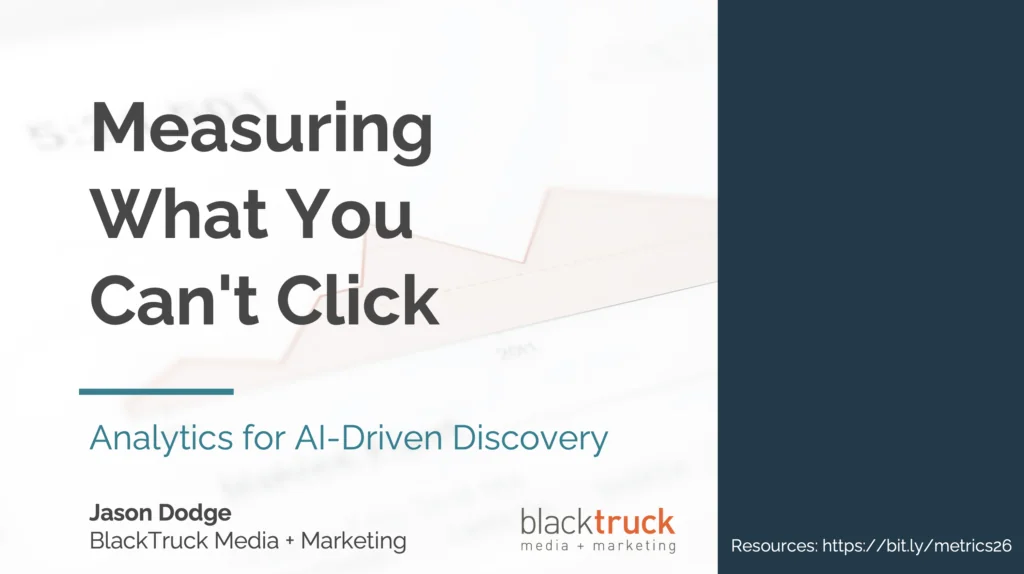
Measuring What You Can’t Click – Analytics for AI-Driven Discovery
As marketers, we’re navigating a measurement crisis that has nothing to do with your actual marketing performance. Re-read that, it’s ok.
AI-driven search is changing how travelers discover destinations, and the website clicks that once validated DMO efforts are disappearing as a result. This session unpacked what actually changed (and what didn’t), why most AI tracking tools can’t deliver what they promise, and how DMOs can build a measurement framework that tells the complete story to their boards and funding partners.
Key Takeaways
Search isn’t dying, clicking is. Google search volume grew more than 20% in 2024, but for every 1,000 searches, only 360 clicks reach the open web. Your destination may be winning in AI results and your analytics would never show it.
Your dashboard was built for a different web. Sessions and bounce rate measure a shrinking slice of a growing pie. DMOs that rely on traffic alone are evaluating performance with the wrong instrument.
Showing up and being the source are two different things. Your destination almost always appears in AI travel answers. The question is whether AI is pulling from your content or from TripAdvisor, Wikipedia, and articles your team didn’t write.
AI ranking tools aren’t measuring what they claim. SparkToro research found less than a 1-in-100 chance of getting the same AI recommendations twice for the same query. Ranking position in AI is not a meaningful metric. Visibility percentage — how often you appear across many queries — is.
The clicks that do come through are worth more. Visitors who saw an AI answer and clicked anyway are higher intent. Segmenting that traffic in GA4 and measuring engagement depth tells a more compelling story than raw session volume.
There are three layers to a complete measurement story. AI visibility (before the click), on-site behavior (what happens when they arrive), and real-world impact data (visitor spending and trips per capita) together give a picture no single metric can.
The board narrative is the most urgent gap. Most DMOs understand the shift internally but can’t explain it to leadership. Building that reporting language now is what protects budgets when traffic numbers become harder to defend.
Nobody has this fully figured out yet. Over $100 million a year is being spent on AI tracking tools, and the first published research validating whether the underlying data was even consistent enough to measure came out in January 2026. Being early is an advantage.
Want to start segmenting your AI traffic out within GA4? Please check out the great resources from our friend Dana DiTomaso at Analytics Playbook for the full tutorial.
Additional Resources
Looking for a little more? Explore a few of our most recent podcasts, articles, and recorded webinars
[Listen/Learn] How Does Gen-Z Plan Their Trips? From TikTok to Short Form Content
[Read/Learn] AI Citations Available Inside Bing Webmaster Tools – What They Show Us
[Listen/Learn] Breaking Down TikTok’s New Travel Ads
[Case Study] Attracting Non-Traditional Audiences To Boost a Resort’s Online Revenue
[Webinar] Discovered, Not Clicked – Marketing in a Zero-Click World