For the better part of the past two years, consistent advice from SEO and GEO consultants, has pointed in a single path forward:
- Get cited by AI models
- Optimized for AI Overviews (AIOs)
- Rewrite your content so that a language model can lift it easily
While it appears an entirely new vocabulary had been invented, this was the work that likely has always been performed by reputable SEO agencies and consultants. As both traditional search algorithms and LLMs continue to be more serving of humans, your content should have always been in alignment with that and not just gaming the system.
The pressure behind all of the growth in these theories is real however. The most recent research by SparkToro and Similarweb, puts zero-click searches at 68% in the United States for the first four months of 2026. That’s up from 60% two years earlier. Meaning, for every 1,000 Google Searches, only 276 clicks now reach the open web.
Cyrus Shepard joined us on this episode of The Redirect Podcast to talk through what the data says about the content that’s still winning, and the content that is quietly dying.
For the better part of the past two years, Cyrus has been running through the numbers. Analyzing more than 400 websites that either gained or lost Google traffic within a 12-month period to better understand what actually earns an AI citation. The result? Not exactly the story that some might be selling you in the AI optimization space.
Tap into the episode below or skim the takeaway and action items further down.
Cited by AI vs. Ranking in Google
Asking anyone working in AI optimization right now on where you should focus your attention, and they likely are going to respond with a tactic related to AI. Cyrus’ research took us the other direction, and this might come as a surprise to some.
It’s great to be in the AI overviews, and you probably should. Great to have citations. But the number one metric to correlate with business success is still the top of the organic rankings
– Cyrus Shepard
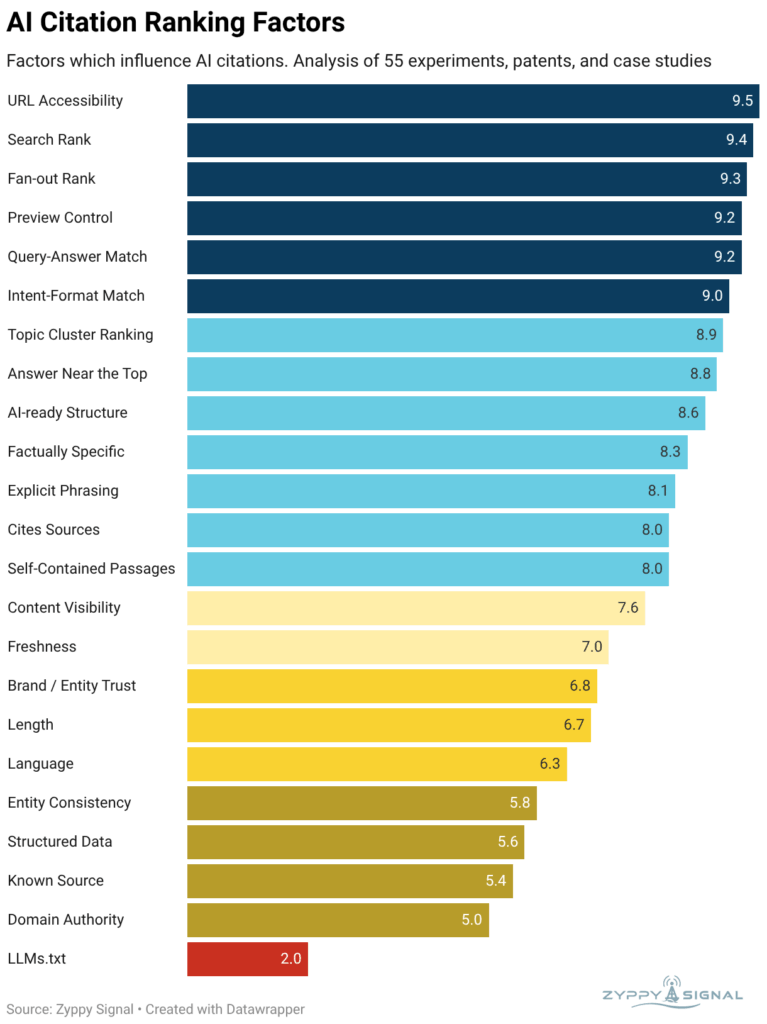
Backing this up with Zyppy’s AI Citation Ranking Factors Analysis, Cyrus broke down the citations studies and scored 23 ranking factors, with evidence-backed results. Traditional search ranking came in second overall, behind only whether or not an AI system can technically access your URL. The signals that earn AI citations turn out to be, in large part, the signal that earned rankings.
There’s a second distinction inside all of the data that’s worth surfacing, and that’s the concept that being cited and being in the answer are not the same thing. Marketers take note: The citation is often the little link you will find off to the side, whereas the answer is the recommendation itself.
The gap currently exists when citation counts are being used as a strategy rather than a trending data point to monitor.
What Indicates a Good Citation Probability?
Over 400+ sites were broken down by business model, content type, and a set of features within each, then measured which features correlated with traffic gains over the 12-months period.
The strongest single predictor was not a content tactic, it was whether a site sells its own product or service. 70% of winning sites sold their own products and services, compared to 34% of losing sites.
Nearly 93% of the winners owned proprietary assets that are hard to replicate, and roughly 84% helped a visitor do something rather than just read something. Meaning, it was their own information that was of helpful nature to others.
The closer you are to the original source of data, the better you’re doing
– Cyrus Shepard
You might read this and ask: Is my brand impacted by this? That will depend on how you classify your business. It certainly could be bad news for intermediaries, affiliate sites, and lead-gen aggregators that are furthest from the source, rather than the business those sites are actually routing people to.
Note: Cyrus is quick to highlight the study measures correlation using third-party traffic estimates, not directly from Google Search Console data, which only the actual site owners would have of course.
Also worth noting are the factors that the study did not find, especially features you would expect to matter. Elements such as first-hand experience, personal perspectives, and user-generated content, showed no measurable difference between winners and losers in the dataset. This doesn’t mean they stopped mattering, it signals to us that previous Google updates likely account for much of that content.
This is also a reminder to not hold any single study as the path forward and you should always be of critical thought when developing your digital strategies.
The Future of Aggregators and UGC
It’s not all doom and gloom for aggregator sites, especially if a publisher owns something that nobody else has as Cyrus points out in his examples of reading the market. An example is Letterboxd, the social film site where users log what they watch and build lists. Similar to a Goodreads, these sites generate millions of opinions and ratings on films (or books), which provides the publisher with a dataset that no other model can reproduce.
The same logic applies to travel aggregator sites that sit on years of user reviews, booking patterns, and cancellation data. Why do you think Google paid $10m for Spirit Airlines’ database? This is original data that most companies will never surface.
Information Has Always Been Evidence
That headline has always remained true in our eyes, and even more so when looking at what’s being surfaced by AI. Cyrus uses RunRepeat as a great model for our discussions. RunRepeat is a website that made a name for itself by cutting hundreds of pairs of shoes in half and publishing what it found inside. Ultimately what you find on their website is full lab reports and not just a summary of each shoe.
These are evidence-backed posts that both Google and the AI models are looking for. They have all the information, but they need a place to go and verify it. Which means the content we create now has shifted from “here’s the information, to here’s the evidence.” It’s easy to publish your findings, but take it a step further and publish your methodology in the process.
About Pages Do More Work Than You Think
This might be a bit of a hot take, but have you reviewed your about page lately and what it actually says about your brand? Google any established brand today and you are likely to find an AI overview:
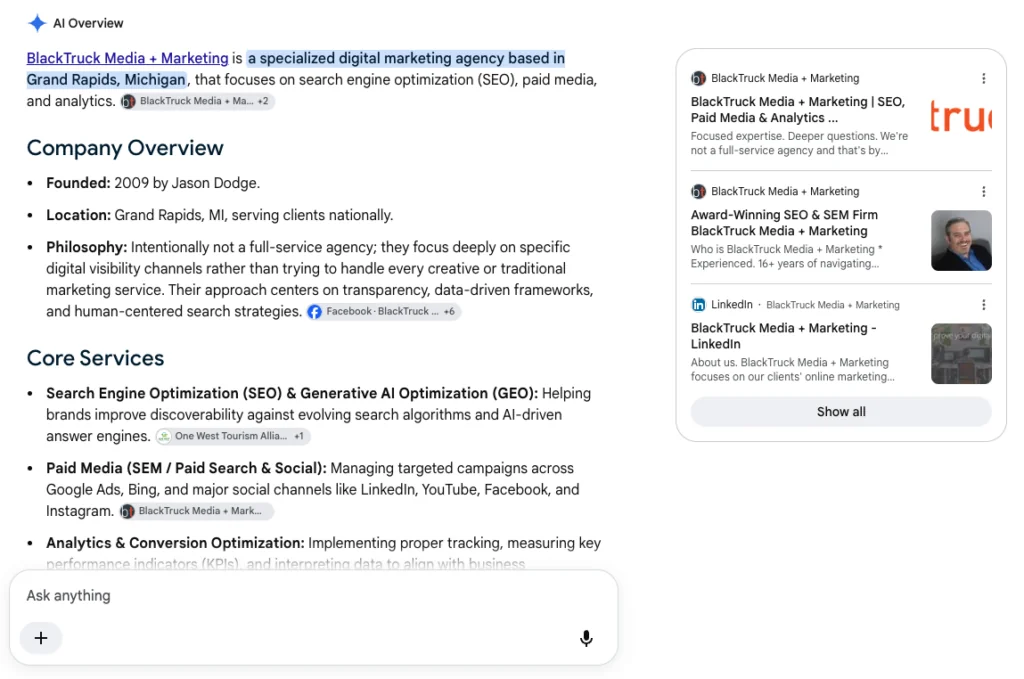
Google’s AI Overview results for who is BlackTruck Media + Marketing?
Most brands have a single About page that is an assembly of story filler. Cyrus argues for a family pages instead, and those focus on what you do, who you help, and what you’re good at. This covers everything from awards, careers, leadership, etc. Does any of this drive meaningful traffic? No, but it helps shape how you get described when someone asks an AI platform about you.
AI platforms have found the skeletons in your brand’s closet, and they’re surfacing them. You need to be telling the same exact brand story throughout the web.
– Jason Dodge
Consistency is the mechanism as AI systems corroborate across many sources. If your site, your LinkedIn, your media coverage, and your directory listings describe you four different ways, you have handed the model four different answers to choose from.
Watch the AI Tactic Trap
Every few months a new formatted approach for optimizing for AI surfaces. Listicles were the format for decades, and we can agree with Cyrus, it’s time to be done with them.
“Right now, listicles have become such poison. There’s still some evidence they work, but I’m scared to touch anything that looks like a listicle.”
– Cyrus Shepard
The timing for all of this is not accidental either. The May 15, 2026 Google update was to its spam policies, stating explicitly that they apply to generative AI responses in Search, including AI Overviews and AI mode. Reporting on this change named biased listicles and recommendation poisoning as examples of what is now in scope.
And while you can argue comparison content is having its moment, it doesn’t mean every brand should go out and develop a bunch of content that pins their brand against competing brands.
Over time, if you have been in the SEO industry long enough, you see tactics work and quickly go away. We chase down listicles one week, then comparison pages another week. None of which brought in meaningful results in the form of leads, sales, etc.
Formatting follows substance and if your comparison page is built on your own testing data, it becomes much more viable than one that uses your competitor’s marketing copy.
Is Agentic Search and Agentic Commerce the Future?
When asked, Cyrus is in alignment with us on what the future of agentic search and commerce looks like right now. It very much is the wild west of agentic SEO and commerce at the moment. Waiting to see what protocols get more standardized and traction gained before going all-in, might not be a bad approach.
This is less about technology and more about trust. Remember your first online transaction and you handed over your credit card number to some website, half expecting to get robbed? We’re not exactly to that stage yet with agents buying on our behalf.
Worth noting is Google’s introduction of Universal Cart, which is a cart that follows you across Search, Gemini, YouTube, and Gmail, flagging price drops and product incompatibilities. All of this is checked out through the Universal Commerce Protocol that has arrived alongside the Agent Payments Protocol. While these are all consolidating quickly, the trust question does come into play. Will adoption grow
Steps to Future-Proof Your Content for AI Search
There’s a lot that you can and should be doing already. We’ve spoken about these themes at conferences and events, and many continue to hold true.
- Audit for proximity, not keywords: Look where your business sits relative to the source. If you’re an intermediary, find the proprietary data you already own and start surfacing it if you can.
- Fund evidence, not word count: Meaning an investment into photography, video, testing, and methodologies behind what you’re actually doing, is a solid move. What does a competitor have to physically do to reproduce your page?
- Expand your about pages into a family: What you do, who you help, your expertise, your leadership, awards, etc. This is low traffic, but high influence on how you’re described.
- Brand continuity is critical: Review your site, social presence, media, directories, etc. AI systems reward corroboration.
- Keep doing traditional SEO: Ranking well remains the strongest lever, even with AI visibility. Don’t defund the strategies that work, in order to chase the newest thing.
- Measure inclusion and not just the citation: Track whether you are being recommended, not only whether you are being linked.
None of this is a shortcut, and that’s the point.
For 20+ years, the SEO playbook had two primary moves and that was to publish content and earn links. That playbook didn’t expire so much as it was commoditized, and once the cost of producing content dropped, the only defensible position left is the things you can produce that nobody else can.
The work didn’t get easier. If anything, it got more honest.
– Jason Dodge
If you have real expertise on a subject, real data, or real product information, this shift will work in your favor. If anything, it’s clearing out the sites that were renting attention on topics adjacent to what they do.
If your content strategy has been to write just a slightly better version of something that already exists, the next 12-months are going to be uncomfortable for your brand.
Curious about whether your content holds up in an AI-first search landscape? Let’s have an honest conversation about where you actually stand. Schedule a time to talk.
Additional Resources
[listen] Why Your Team Might Not Be Ready for AI Search
[listen] AI Optimization: Separating Hype from Reality on The Redirect Podcast
[read] Google Local Services Ads: Are They Right For Your Business?
[read] Leveraging Strategic Partnership to Grow Organic Revenue and Boost Visibility
Explore The Redirect Podcast over on YouTube as well.